Bring the outside in this Easter

I have more than 100 houseplants as I love being surrounded by the sight, smell and textures of flowers and greenery. In addition, I look for other, easy ways to bring the delights of the natural world into my house. This is especially important in colder months when I am outside less.

I’d like to share some easy ways you can bring plants and flowers inside this Easter (and throughout Spring).

  • Bring in branches and stems of flowering plants like Cherry or Almond blossom, pussy willows with furry catkins or bright yellow forsythia and pop them in a vase!
  • Put bulbs (from your garden or buy in pots) into a miniature garden. I used anemone and grape hyacinths (Muscari). Finish off with moss (I pulled this out of our lawn!) and a homemade birds nest. I found pliable hazel, birch and cornus twigs and wove them into a circle. To keep them tightly together I used string to tie knots and left the ends untidy to make it look like there were pieces of string in the nest. The daffodils I picked in our garden and poked into the moss. They didn’t last more than 12 hours, but would be perfect for an Easter table.
  • Create a small table arrangement. I used a flower pot lined with foil and filled it with soaked oasis foam*. I cut greenery, twigs and pussy willow / forsythia to add some colour and interest.

You can see all these arrangements, and how to make them, in a video on my Facebook group The Cactus Surgeon, a private group that you’d be welcome to join. Together we celebrate nature’s small wonders.

I believe that by connecting with nature we can create joy and find some peace, even on the hardest of days. Vincent Van Gogh said, “How wonderful yellow is. It stands for the sun.” I couldn’t agree more. And, at this time of the year it is a symbol of Spring. A reminder that longer, warmer days are on the way.

Pussy willow catkins are tactile, and I challenge you to pick some without stroking them! I bet you can’t. I don’t have this or forsythia in my garden but asked a friendly neighbour if I could pick some from two huge bushes in his garden, which hang over the verge. Most people are more than happy to share their bounty. If you can’t find any look for bunches of cheerful yellow daffodils or potted bulbs which can be put in the garden after you’ve enjoyed them in the house. I do this every year and am building up quite the collection outside.

*this year I hope to find a more sustainable replacement for Oasis foam, but for now I am using up old stocks.

Skipping into Spring

Last weekend I was lucky enough to see flocks of hundreds of birds (Goldfinches?) feeding on Millet seed heads in a field. It was a wondrous sight, and the chattering, melodic sound filled the air and followed me as I reluctantly walked away.

Winter is the best time to enjoy lichen, before the trees are full of leaves again. I’ve recently learnt that lichen is two organisms living in the same body!! One is a fungus and inside is a green alga. Mind blowing stuff and confirmation that nature is amazing. Not that I needed any convincing! Thanks to The Wonders of Nature for that fact, a book I bought for my daughter because secretly I wanted a copy. My love of nature stems from my childhood – picking up facts from my parents and grandparents but also from a couple of nature books. One had a picture of a dissected owl pellet – full of tiny bones – which opened my eyes to the wonders of the food chain. And the Osborne book of birds eggs had me enthralled.

This week I bought two new houseplants and have been raving about them to anyone who will listen. Firstly, Orchid Oncidium ‘Twinkle’ (pictured), which has tiny cream and orange flowers which smell like a tropical greenhouse, with hints of Vanilla. It smells more strongly in the morning and makes me happy every time I walk into the kitchen. And then I came across Dischidia ‘Pangolin Kisses’ with its fleshy, scale-like leaves. A sculptural, interesting plant with a super cool name. Definitely two to look out for.

I’m Skipping into Spring this March, for Garden Releaf Day in aid of Greenfingers. They build beautiful gardens for children’s hospices and bring joy to so many people’s lives, at a time in their lives when joy is hard to find. I’ve committed to skipping every day and can now manage 5 minutes. I am not very fit and I’ve had many soft tissue injuries as a result of Functional Neurological Disorder. Since my daughter was born eight years ago my hips really don’t like to be stretched – so it’s a real challenge for me. Please do sponsor me if you can. Everything I raise will be match funded by Perrywood.

UPDATE – Sadly my hips did not like the skipping and later in the month I had to withdraw from the challenge. I did pay to wear my floral top on Garden Re-leaf Day and in total we raised £500 for Greenfingers.

Happy Houseplants

I love having plants around me at home. They make me happy. And apparently, we all have “the urge to affiliate with other forms of life.”  The is called biophilia, a term popularised by biologist Edward Wilson in 1984. There is a wonderful book all about it by Sally Coultard, which is well worth a read.

There is a lot of research which proves the beneficial effects of having plants and other natural materials in our homes. It can destress us, lowering blood pressure. It gives us something to care for, which can be very positive for anyone struggling with their mental health. And plants can purify the air (although so can opening a window!).

Doesn’t it make sense, that as a species that once roamed the earth living and surviving in such close proximity to nature, we should still have an innate craving to be near it today?  

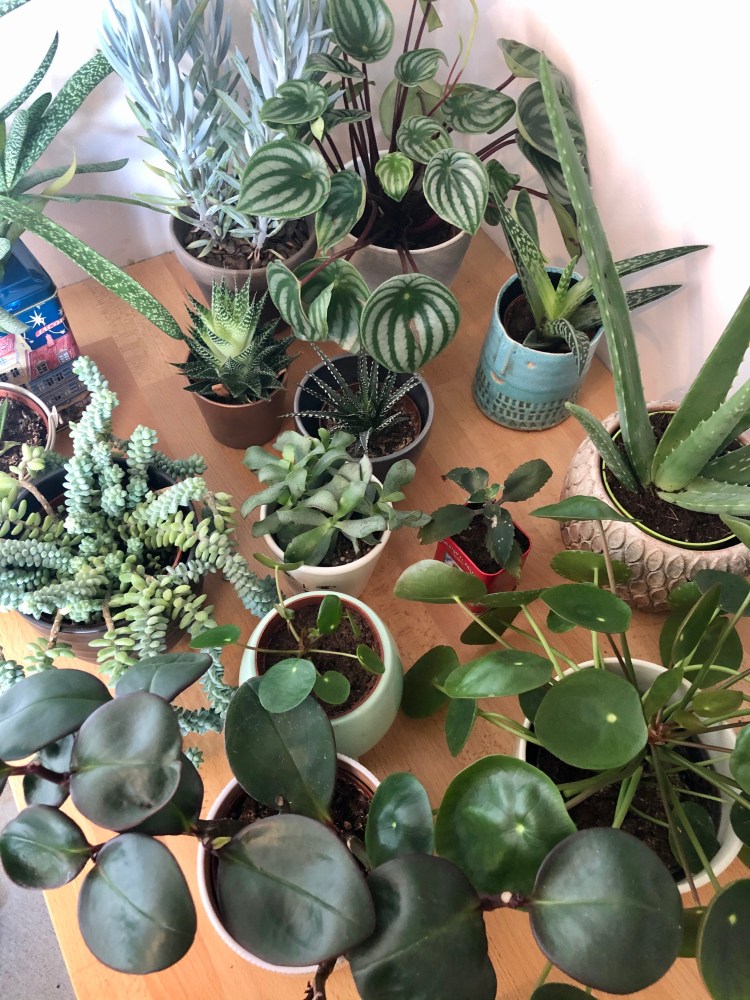
Confession time. I tend to neglect my houseplants. They are under-watered rather than overwatered, so my collection of more than 100 plants is mainly made up of those which can withstand this treatment. Anything which requires more attention doesn’t tend to last very long.

These are some of my favourite foliage plants.

I have a lot of succulents which have fleshy stems and leaves and require minimal watering.

Senecio (left) and Watermelon Peperomia (right)

Houseplants can be fun to propagate. It’s an easy and cheap way to grow your collection or share it with friends and family. Many can be grown from a stem or a leaf. I took the baby Pilea from next to the mother plant. The Kalanchoe I broke off a stem and put it in soil. The Peperomia I snapped off some stems and have them in a jar of water until the roots grow longer. I will then pot them up.

Jam jar propagation – look at the tiny roots!
Pilea (left) and Kalanchoe Mother of Thousands (Right).

Visit my Facebook page to watch a tour of some of my favourite houseplants. I can’t help but wonder why I didn’t get more houseplants in my life while I was in London. They weren’t trendy back then but I should have worked harder to surround myself with greenery – both at home and in the office. Maybe it would have given me something to care about, and in doing so I might have slowed down and noticed the world around me. Perhaps in doing so I would have noticed how I was, and looked after myself better? I hold no regrets, but I know that for the rest of my life I will always surround myself with plants. It brings me a lot of joy.

Create a mini nature reserve.

You can attract wildlife to your garden because it’s the right thing to do (and it really is, for so many reasons). Or, like me, you can do it because it will bring numerous moments of joy and pleasure to your life.

Here are some ideas from my garden over the last ten years that have really worked for me.

More birds please!

  • Fennel (pictured above) grows huge and this Winter I’ve had Blue Tits and Warblers feeding on the seeds. I have no idea what type of Warbler as they all look the same – small and brown. I was excited nonetheless!
  • We’ve had Redwings, Fieldfares, Mistle Thrushes, Song Thrushes and Blackbirds feeding on our neighbours Holly, Cotoneaster and Sorbus berries. Without the berries, they wouldn’t be in our garden. I’m now planting some on our side of the fence.
  • Feed the birds and put up nest boxes. Every day I watch and smile. Today a Sparrowhawk swooped past the kitchen window. I use a variety of feeders; fat balls, sunflower seeds (these or Nyger seeds are essential for attracting Goldfinches), peanuts and mixed seeds. Make sure there is cover for the birds not far from the feeders, they like to dart into a hedge at any sign of danger.
  • Buy a birdbath. Is there anything more wonderful than watching a bird having a dip? A saucer would work just as well and is more suited to an informal garden. Our bird bath is tucked in among the shrubs, it doesn’t have to be a key feature. We also have a barrel pond with pebble beach, which is great for both birds and insects.

Insects need homes too.

  • Build log piles or bug hotels – they don’t have to be scruffy if you don’t want them to be. We’ve filled three garden gabions (wire metal squares) with bark, sticks, stones, shells and leaves. They look nice and double up as a home for creepy crawlies.
  • Bee Hotels are wonderful for solitary bees. They lay their eggs in them and cover up the hole. We have fun counting how many hotels are occupied. Buy one or make your own.

Nature doesn’t like a tidy garden

  • Overly manicured gardens won’t have as much wildlife! Leave piles of logs and leaves, keep some of the grass longer, allow nettles to grow in a more wild area.
  • It’s easier to do this in a larger garden, but even in a smaller garden it’s possible. Don’t cut back seed heads and dead perennials for example, leave them for ladybirds to crawl into, and for birds to eat the seeds.

My Grounded Garden Bird Watch

I on a kitchen chair in front of the window. I’m excited and ready to go, with a cuppa, bird books, paper and pen beside me. I relish an hour of focusing only on the natural world for the RSPB Great Garden Bird Watch. It feels like a luxury, and every year I think I must do this more often. I never do.

Outside, it’s only 4 degrees Celsius. The birds are keen to feed and increase their calories. The Blue Tits and Great Tits are already in attendance. They quickly dart from branch to branch, from feeder to feeder. The Blue Tits are happy to eat quickly at the feeder. The Great Tit takes a seed to eat elsewhere.

House Sparrows come down in flocks, chirping and chattering as they dart in and out of the honeysuckle and onto the feeders. Hierarchies are worked out and redrawn. Then “Ch-ch-ch-ch-ch.” Warning cries ring out and the birds all flee together back into the protection of the Honeysuckle.

After 15 minutes I am fully tuned in to activity in the garden and I begin to resent household noises. I am desperate to scream, “Go Away!”. My poor husband. He is only drying up and has no idea that I have entered a mindful trance. I ask him nicely to leave.

I can strongly feel where my body connects with the chair and the floor. I feel grounded, like when I complete my Tai Chi circles. It’s a lovely feeling but can also be a wakeup call. Noticing my aches and pains, and my tiredness, I remember I am not bulletproof. Suddenly, fatigue is not far away.

The Goldfinches appear. Delicate & beautiful; the prima donnas of the bird ballet. I get a hit of endorphins when I see a Mistle Thrush sitting atop the fir tree, its breast creamy white and speckled brown in the sunshine. The regal King (or Queen?) of the castle in its lofty perch.

The birds ebb and flow. With ten minutes to go the garden is suddenly devoid of birds. I feel bereft. I don’t want the count to end with silence. To my delight with just four minutes left there is a sudden flurry of activity again.

Finally, my hour of watching the birds is complete, and I am happy.

My final tally (after adjustment). On my paper in the picture I had counted total seen, and it should be total seen at any one time. Thanks to my friend Louise I realised my mistake!

  • House Sparrow – 10
  • Blue Tit – 8
  • Great Tit – 5
  • Robin – 3
  • Wood Pigeon – 2
  • Magpie – 2
  • Goldfinch – 3
  • Mistle Thrush – 1
  • Blackbird – 1
  • Chaffinch – 1
  • Common Gull – 1
  • Collared Dove – 1

Small wonders don’t always happen by chance

I’ve had a medium size garden for nearly ten years now. With careful consideration (and some happy accidents!) I have ensured that we are regularly wowed by small wonders of nature. Here’s what I’ve learnt:

  • Embrace nostalgia
    • Plant something you remember from your childhood, or which you associate with someone you love. Every time you see it, you will feel a warm glow. The sight and smell of strawberries and tomatoes take me back to eating them as a child.
  • Create joy
    • Plant pretty flowers you can pick and bring inside; it’s also lovely to pick them for other people. This year I will be growing Gladioli, Dahlia and Cosmos alongside my vegetables.
    • Put grasses in a spot which gets the first or last of the day’s low sunshine. The graceful seed heads will create stunning shadows, and you won’t be able to stop looking at them and taking photos. The grasses pictured are in a beautiful Suffolk gravel garden.
    • Repetition is very pleasing. If you plant Alliums for example plant 12 not 3.
    • Read Joyful by Ingrid Fettel Lee if you are curious about what makes us joyful, and why.
  • Brighten up sparser months
    • Plant bulbs. There is nothing more joyful than seeing bulbs coming up in the Spring when the rest of the garden is still resting. The flowers attract giant bumblebees grateful for this early source of nectar.  If some are in pots, you can bring right up to the doorstep. This morning I noticed something new in my front garden which had popped up after yesterday’s warmer weather – Iris reticulata ‘Katharine Hodgkin’ which is pale blue with perfect dark blue and yellow markings. There were only two flowers but at this time of year it was enough to really make me smile.
    • Create a garden for all seasons. If you only buy plants once a year, you will miss the best plants from the other three seasons.
  • Create a mini wildlife reserve
    • Fennel grows huge and this Winter I’ve had Blue Tits and Warblers feeding on the seeds
    • We’ve had Redwings, Fieldfares, Mistle Thrushes, Song Thrushes and Blackbirds feeding on our neighbours Holly, Cotoneaster and Sorbus berries. Without the berries, they wouldn’t be in our garden.I’m now planting some on our side of the fence.
    • Feed the birds and put up nest boxes. Every day I watch and smile. Today a Sparrowhawk swooped past the kitchen window.
    • Buy a birdbath. Is there anything more wonderful than watching a bird having a dip? We also have a barrel pond with pebble beach, which is great for both birds and insects.

It’s also worth paying extra attention to your garden when the weather changes. Hotter, colder, snow or rain. All can change the behaviour of animals and birds. I saw a Long Eared Owl in our garden on a snowy day in 2012! My best ever nature spot.

Next time you redesign an area of your garden think about the joy it might bring you in the future. You might think differently about what to put there!

Long Eared Owl in the garden on a snowy day.

Tune into small wonders

In 2009 I burnt out and was diagnosed with a Functional Neurological Disorder. I would twitch and jerk in response to sound or touch. I looked like a peculiar air drummer, with no rhythm. These disorders, which in other people can cause a whole host of symptoms, including paralysis, seizures and blindness, are not structural. Tests come back normal. They are ‘functional’, that’s to say our brain’s function is affected and it sends the wrong signal to parts of our bodies. Which is ironic because we can’t function. I took six months off work and spent a month virtually confined to my flat or the nearby pavements.

There was very little information available to help me, and the diagnosis journey took several months. I found my own way to get better. Cranio-Osteopathy, Acupuncture and Counselling became my holy trinity. My practitioners and boyfriend were my lifelines, each helping me inch my body back to better health. By the time I was diagnosed, the neurologist and psychiatrist discharged me. They told me to continue with my own approach.

Living in London near the Thames, I took daily walks and set myself the challenge of taking one good photo every day. Some were manmade objects – textured rope on the dock, architecture or ‘street photography’, snapping at people sitting on benches.

More life-affirming were the small wonders of nature. I became obsessed with them, and they gave me a reason to get dressed and go out for my daily walk. Walking triggered my ‘twitches’ so this was no mean feat.

I saw leaves sparkling with perfect rain drops, verdant moss, weeds growing in pavements, swans and grebes nesting and pots full of vegetables on houseboats. On days I couldn’t leave the flat I took pictures of houseplants or gazed at the London Plane Trees filling our window with green.     

My life was in limbo, but around me, plants were growing; the seasons were changing, and there were moments of pure joy to be found. Seeking out these positives played a huge part in helping me heal my body and mind. During this pandemic, when our world is forcibly shrunk, I recommend you tune into the small wonders of nature – be it in your garden, park or on your well-trodden local walk.