Are we doing those who are sensitive a disservice?

It’s my stop on the Blog Tour for Sensitive by Hannah Jane Walker.

Here is some of the book’s info: Hannah Jane Walker is a very sensitive person, along with at least a fifth of the population. Like many, she was conditioned to believe this was a weakness and a trait that she should try and overcome. When she had her first child and realised that her little girl was sensitive too, Hannah decided to find out whether sensitivity might in fact be a positive trait. Her question led to some fascinating answers and ongoing research that suggests survival and thriving is not only limited to the fittest, but to the sensitive.

I was fascinated by this book. I read The Highly Sensitive Child by Elaine Aron a couple of years ago, and so was interested in Hannah’s take on the subject of sensitive people. I enjoyed how she combines accounts of her lived experiences with wide-ranging expert interviews. Her research is extremely thorough, thought-provoking, and some salient points shall stay with me, which is generally the sign of a good book.

I was particularly interested in the observations about our connection with nature, now compared with the past. Hannah tells us, “To live in balance with environment requires the skill of sensitivity – to hold the idea of ourselves as part of something”. When I suffered burnout and functional neurological disorder in 2009, I felt like I was missing a layer of skin – physically and mentally. I was stuck in hyper sensitive mode. Nature was one of the things which helped me to heal. I was able to tune into it in a more intense way than I had ever done previously, and it helped me to feel part of something bigger than myself. This gave me hope and a break from my day to day worries.

And the chapter about gut instinct was fascinating. It referenced interoception – the brain’s awareness of your bodily state – which I first heard about when I took part in the Uncertainty Experts. To use interoception is to listen to our brain’s conversation with our body. Boy, I wish I did that as I was heading to burnout.

This book will appeal to anyone who is sensitive or hangs out with sensitive family or friends. And to anyone, like me, who is super curious and wants to learn more about people. The biggest lesson I take away from books like this is that we are all different. This book in particular, demonstrated that there is a sliding scale of sensitivity, and we need people from across the spectrum – both in our work teams and in society as a whole. The positive traits are not always celebrated as much as they should be. On a more specific note, in the chapter about sensitive people at work HR Consultant Christine Garner gave advice for team meetings. I will do my best to offer diverse ways for people to contribute and give feedback. Some people, particularly highly sensitive people, may need more time than is offered to contribute.

Phrases like “they are too sensitive” are almost always used as a pejorative, a way to put someone down or to move away from emotions which make us feel awkward or embarrassed.

I hope this book helps those who are sensitive to find their place in the world. And for me? I will be more careful how I use the word sensitive and will continue my quest to be understanding of others.

I was gifted a copy of the book in return for an honest review.

Hannah Powell is a book blogger, author and director of two garden centres. Her award-winning memoir, The Cactus Surgeon, compares her days in the concrete of London, leading to burnout, with her nature-rich upbringing in rural Essex. It’s a nature and health memoir full of mindful moments.

Changing my relationship with food

I have suffered from IBS for years. I have tried acupuncture, seen nutritionists and been on a low FODMAP exclusion and reintroduction diet via a dietician. Nothing really worked, and the list of food I am triggered by has got longer every year.

So, for the last six weeks, I have been persevering with the Nerva app, a hypnotherapy app which is clinically proven to improve IBS symptoms for 80% of users. It’s best if you do it every day for six weeks. I managed nearly all of the sessions. I had tried it twice previously but didn’t fully commit and couldn’t get past week one. This time I had a strict word with myself, saying there was no other option and that I had to do the sessions if I wanted to get better. I did really well until week 6, when we rehomed a rescue dog and my days/brain were fully consumed with dog-related tasks.

Nerva is an evidence-based digital therapeutic that uses gut-directed hypnotherapy to help you create a positive relationship between your gut and brain. It targets the source of the problem: oversensitive nerves in the gut, and teaches you how to address this miscommunication between the gut and brain.

As well as hypnotherapy, you get daily articles to read and breathing exercises to bring your body out of the fight-or-flight state (sympathetic nervous system response) that amplifies IBS symptoms.

Hypnotherapy is very relaxing. I found I have to do it in the daytime, as if I do it in the evening, I fall asleep. Being ‘under’ feels a bit like when you are nearly asleep and can hear everything around you but can’t move and are in a trance-like state. The positive suggestions I heard whilst hypnotised were very powerful. I felt myself smiling during and afterwards at the thought of my symptoms getting better and better. I hadn’t realised how hypervigilant I had become about food.

The results have been good, and I’d definitely recommend it. I am much more relaxed about eating foods which I would have previously seen as trigger foods, and I have had fewer symptoms. I went to a conference at the end of January where normally I would expect to have a bloated stomach, pain and wind because it would be impossible to avoid the things I stay away from at home – garlic and onion, for example. However, I was very chilled this time and even tucked into some of the batter on my fish and chips without even thinking about it, which is normally a no-no for me unless I know it’s gluten-free. I didn’t even ask what was in it and felt fine afterwards. It’s a huge relief to worry less, and I’m sure it will continue to reduce symptoms. Studies have shown hypnotherapy can provide long-lasting IBS management.

Moving forward, I will be much more relaxed when I eat out and will also start to experiment more with foods that have been on my no-list. I will continue with the maintenance programme they offer to ensure my progress continues.

Three things I’ve learnt during this process:

  • I have to be really committed to introducing a new habit to my week – even finding 15-20 mins per day was hard and became impossible when I had a dog to fit into my daily routine.
  • Hypnotherapy is powerful. I’d definitely consider it for other things. It can make a change; all you have to do is listen and be open-minded.
  • Food is not the enemy! Rather, my brain and gut have become misguided, and they can be retrained.

Song of Silver, Flame Like Night

I am a huge fan of fantasy books, but they can be predictable. If you’ve read a few, you know what I mean. Song of Silver, Flame Like Night is a breath of fresh air. It’s set against a rich backdrop inspired by Chinese mythology. The lead characters, Lan and Zen, are multi-faceted and intriguing, and I felt invested in their stories from the first few pages. The peripheral characters are no less interesting and left me wanting more.

The book is fascinating whether you know anything about Chinese myths and legends or not. My only link to China is the Tai Chi I practice once a week! Amelie is a captivating writer. Each chapter is fast-paced, and the plot twists and turns. She is not sentimental with her characters, so you never really know who will survive. Having finished, I definitely want to know when the sequel is due.

More about the book:

Once, Lan had a different name. Now, she goes by the one the Elantian colonizers gave her when they invaded her kingdom, killed her mother, and outlawed her people’s magic. She spends her nights as a songgirl in Haak’gong, a city transformed by the conquerors, and spends her days scavenging for remnants of the past. For anything that might help her understand the strange mark burned into her arm by her mother, in her last act before she died. No one can see the mysterious mark, an untranslatable Hin character, except Lan. Until the night a boy appears at the teahouse and saves her life.
Zen is a practitioner – one of the fabled magicians of the Last Kingdom, whose abilities were rumoured to be drawn from the demons they communed with. Magic believed to be long lost. Magic to be hidden from the Elantians at all costs. Both Lan and Zen have secrets buried deep within. Fate has connected them, but their destiny
remains unwritten. Both hold the power to liberate their land. And both hold the power to destroy the world.

I was gifted a copy of Song of Silver, Flame Like Night in return for an honest review.

Hannah Powell is a book blogger, author and director of two garden centres. Her award-winning memoir, The Cactus Surgeon, compares her days in the concrete of London, leading to burnout, with her nature-rich upbringing in rural Essex. It’s a nature and health memoir full of mindful moments.

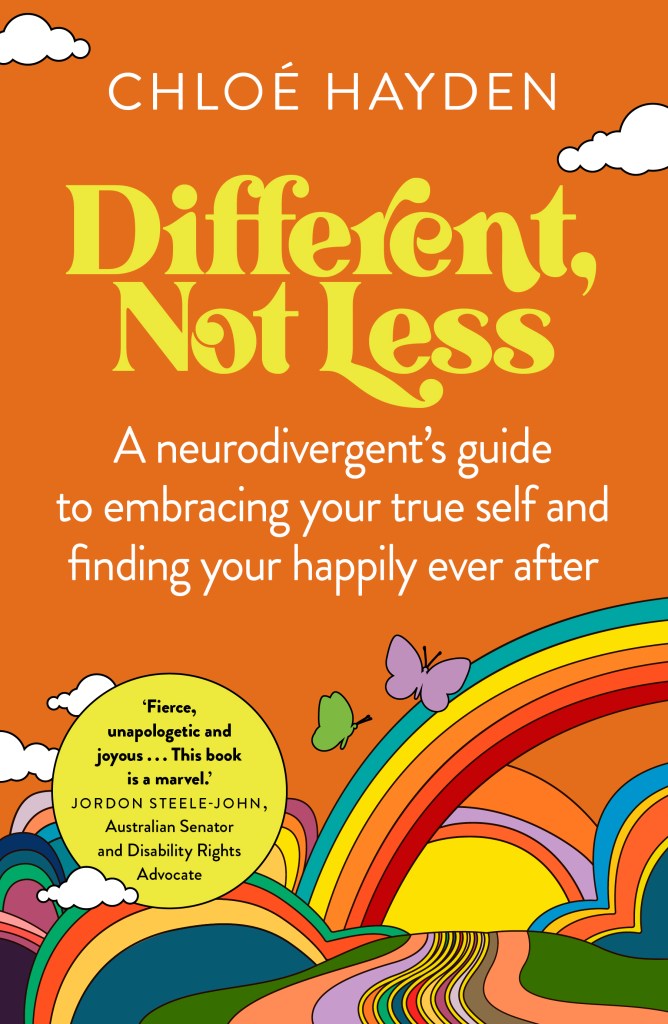
Different, Not Less

I was gifted a digital copy of Different Not Less by Netflix’s Heartbreak High star and disability advocate Chloe Hayden as part of a Random Things Blog Tour.

Growing up, Chloé Hayden felt like she’d crash-landed on an alien planet where nothing made sense. Eye contact? Small talk? And why are you people so touch-
oriented? None of it made sense.

Chloé desperately wished to be part of the fairytales she so dearly loved. A world in
which the lead is considered a hero because of their differences, rather than excluded
and pushed aside for them. She moved between 10 schools in 8 years, struggling to become a person she believed society would accept. After years of being ‘weird, quirky, Chloé’ she was eventually diagnosed with autism and ADHD. It was only after a life-changing group of allies showed her that different did not mean less that she learned to celebrate her true voice and find her happily ever after.

I found it enlightening and informative. I especially liked how it was not only full of Chloe’s lived experiences but also packed with her useful tips. For example (and this is great advice for everyone!): Curate your Instagram feed and fill your bookshelves with humans of different body types, neurotypes, sexualities, genders, ethnicities…create a new normal. There is also advice for women on handling their periods, when their sensitivities may be heightened, and managing mental health and burnout.

I can imagine that this book would be extremely helpful for neurodivergents to read and will help them feel seen and understood. For me (a neurotypical), reading this book was like peeling back the many layers of an onion. It was difficult to read in parts because of some of Chloe’s experiences, but it was also a privilege to read it, and I learnt an awful lot. Chloe’s perspective on life is both eye-opening and heartfelt.

It feels like we are living in a time of positive change. Whilst there is a way to go, I hope we look back on the 2020s as the start of an era when being neurodivergent is truly seen as being different, not less. Bravo Chloe.

I’d recommend this book for neurodivergent teens or adults. Also, for anyone else who is curious and who wants to understand better and support the neurodivergent community.

If you think you know trees, think again!

Thirteen Ways to Smell a Tree: A celebration of our connection with trees is a small, easy-to-read non-fiction book packed with facts and insights – both historical and modern-day. The author, David George Haskell, took me around the world to get up close and personal with some of the world’s most marvellous trees, including one of my favourites, the Ginko, and one I’d never heard of, the American Basswood. He also encourages readers to explore trees outside of their natural habitat, closer to home, through the aroma of books, gin & tonic and olive oil.

This book reminded me to open my nostrils and focus on scents when surrounded by trees. I love being reminded to engage with nature in different ways. It is so essential to our fight against climate change. Those who connect with the natural world are far more likely to take action to avoid further damaging our amazing green planet.

After reading, I stepped out of the house I was staying in, where I have been many times before I was knocked backwards by the scent of the lavender outside the door. The book had focused my mind on my sense of smell, and I was now primed to enjoy the soporific, soothing aromas oozing from the small, unassuming bushes in front of me. The book served as a great reminder not to only rely on my eyes and ears when I am out and about.

If you think you know trees, think again. It would make a great present for nature lovers or for anyone who is curious and loves to learn.

I was given a free copy of the book in return for an honest review by Random Things Tours.

Hannah is the author of The Cactus Surgeon, a nature & health memoir. Living in London, Hannah suffered burnout and was diagnosed with a functional neurological disorder. With no information available to help her, she found her own way to get better.

Growing up in a garden centre, her childhood was full of nature and plants. This starkly contrasted with the concrete of the capital, where she became unwell. In searching for the answers to her illness, she wonders whether being torn from her pot and replanted in a more hostile environment was why her body started to malfunction.

After seeking out alternative therapies, and moving to the countryside of North Essex, her ‘green recovery’ continued. It’s a book of mindful moments, savouring the small wonders of nature.

An unreliable biography

It’s my stop on the blogger tour! The Call of the Cormorant is Donald Murray’s unreliable biography of Karl Einarsson, a child born in the Faroe Islands who became a serial scammer living in Nazi Berlin. It was more like a wholly fictional tale, so outrageous was Karl’s life. It’s a very unusual book, full of intriguing references to places I have never been to (and can’t even pronounce!).

From the author of the prize-winning As the Women Lay Dreaming comes a remarkable ‘unreliable biography’ of Karl Kjerúlf Einarsson: an artist and an adventurer, a polyglot and a performer, a charlatan and a mountebank, forever in search of Atlantis. As a child in the windswept, fog-bound Faroe Islands in the late nineteenth century, Karl Einarsson believes he is special, destined for a life of art and adventure. As soon as he can, he sets out for Copenhagen and beyond, styling himself as the Count of St. Kilda. He’s an observer and citizen of nowhere, a serial swindler of aristocrats and Nazis, fishermen and fops. But when his adventures find him in 1930s Berlin, he is forced for the first time to reckon with something much bigger than himself. As the Nazis rise to power around him, his wilful ignorance becomes unwitting complicity, even betrayal. Based on a true story, this is a fantastical tale of island life, of those who leave and those who stay behind, and the many dangers of delusions and false identities.

The characters are extremely well observed. Karl is not a likeable fellow! I enjoyed the inclusion of narration from others around him, allowing us to see his full character, for good and bad. He was a child with such potential and a desire to travel, yet he ultimately used his talents and ability to mimic for ill-gotten gains. In stark contrast, his sister Christianna leads a much less rich life and, despite temptation, stays on the right side of the law and morality. Her presence grounded the book and reminded us how Karl could have gone down a different path.

Donald’s writing is interesting, unpredictable and unusual. He brings in all sorts of literary references, giving me a real understanding of the time’s dark historical events and conspiracy theories.

Donald S Murray is a writer and poet whose work has been awarded The Society of Authors’ Paul Torday Memorial Prize and the Callum Macdonald Memorial Award at Scotland’s National Book Awards 2021. His critically acclaimed books bring to life the culture and nature of the Scottish islands, and he appears regularly on BBC Radio 4 and BBC Radio Scotland.

Donald Murray

I was given a free copy of the book in return for an honest review by Random Things Tours.

Hannah is the author of The Cactus Surgeon, a nature & health memoir. Living in London, Hannah suffered burnout and was diagnosed with a functional neurological disorder. With no information available to help her, she found her own way to get better.

Growing up in a garden centre, her childhood was full of nature and plants. This starkly contrasted with the concrete of the capital, where she became unwell. In searching for the answers to her illness, she wonders whether being torn from her pot and replanted in a more hostile environment was why her body started to malfunction.

After seeking out alternative therapies, and moving to the countryside of North Essex, her ‘green recovery’ continued. It’s a book of mindful moments, savouring the small wonders of nature.

A book celebrating the joy of front gardens

This book heroes 20 commonly found plants growing in the front gardens of one road in London. Ben’s observations in Grove Park – such as hollyhocks growing at number 92 being ‘serotonin for the summer soul’ – are insightful and full of joy. Ben takes us with him as he walks up and down the street in all weathers and seasons, often with his baby in tow.

The book is so much more than the sum of the 20 plants and the front gardens they call home. He cleverly uses the front gardens as a vehicle to share both local and botanical history. The Grove is packed full of fascinating facts, as well as quotes from relevant poems, books and journals. It’s very carefully researched and in each chapter whilst Ben starts with a single plant he takes us to a much bigger world, that unfurls like a beautiful flower as you turn the pages.

His career as a gardener enables him to give a wider perspective. In the chapter about the rose, he observes, “The need to do causes more damage in gardens than benign neglect ever has.” He shares snippets of his experiences gardening for others, including the very wealthy.

I lived in London for a decade, in two flats, two maisonettes and in a small townhouse. My routes to and from work would always take the most botanical route possible. In a world of concrete and tarmac the seasonal highlights shone out like beacons. Spring was astounding. The parks decorated with cherry blossom and houses draped in wisteria were a much needed balm. Thank you Ben for taking me back there and reminding me of the joy plants brought to my life as I walked around the city and overcame physical and mental health challenges. Having grown up living next to a garden centre, London was something of a shock to the system. The plants were a connection to home, colours and scents dialled up as they nestled against their grey, urban backdrop.

I was given a free copy of the book in return for an honest review, by Random Things Tours.

Hannah is the author of The Cactus Surgeon, a nature & health memoir. Living in London, Hannah suffered burnout and was diagnosed with a functional neurological disorder. With no information available to help her, she found her own way to get better.

Growing up in a garden centre, her childhood was full of nature and plants. This was in stark contrast to the concrete of the capital, where she became unwell. In searching for the answers to her illness, she wonders whether being torn from her pot and replanted in a more hostile environment was the reason her body started to malfunction.

After seeking out alternative therapies, and moving to the countryside of North Essex, her ‘green recovery’ continued. It’s a book of mindful moments, savouring the small wonders of nature.

A no-holds-barred extreme health memoir

Life & Death Decisions by Dr Lachlan McIver packs a punch and gets a five-star rating from me. It gave me everything I want from a memoir, containing jaw-dropping stories, a reminder of human resilience and fragility and a warning about the very real consequences of climate change.

The medical challenges Lachlan has faced as a doctor in Australia and the Pacific Islands are not for the faint-hearted. He has saved countless lives, often in the most basic of conditions. We follow his journey from job to job, battling to save strangers from illnesses, accidents, tropical diseases and war wounds. All the time wishing there was more medicine, staff and equipment.

Lachlan’s own foray into medicine came after the sudden death of his father in a bid to prevent anyone else from suffering a similar tragedy. He throws himself into study, work and life with an unnerving attraction to risk, hard work, booze and drugs. His fearlessness as a doctor keeps him going for years until alcoholism catches up with him, he crashes into bankruptcy and depression and learns that if you don’t rest your mind and body, it will catch up with you. I, too, have learnt this the hard way, although, in retrospect, my experience has been extremely tame compared to Lachlan’s!

His writing matches his character, quickly moving us from event to event. There is some reflection but little time to dwell on things too much. Again and again, his life moves on, and he moves from place to place to find fulfilment and happiness, chasing opportunities in 30 countries worldwide.

Lachlan’s experiences show us climate change is having a negative effect on human health, with communities in tropical places finding their weather patterns are changing and diseases are becoming much more common. I love how he combines his doctoring with his work for the World Health Organisation and Medicins San Frontieres. He isn’t afraid to take risks, yet it’s clearly his talent for rural medicine, data analysis and spotting trends that opens many doors. This book will inspire you to follow your dreams. It will also warn you to look after the planet and yourself along the way.

I was given a free copy of the book in return for an honest review, by Random Things Tours.

Hannah is the author of The Cactus Surgeon, a nature & health memoir. Living in London, Hannah suffered burnout and was diagnosed with a functional neurological disorder. With no information available to help her, she found her own way to get better.

Growing up in a garden centre, her childhood was full of nature and plants. This was in stark contrast to the concrete of the capital, where she became unwell. In searching for the answers to her illness, she wonders whether being torn from her pot and replanted in a more hostile environment was the reason her body started to malfunction.

After seeking out alternative therapies, and moving to the countryside of North Essex, her ‘green recovery’ continued. It’s a book of mindful moments, savouring the small wonders of nature.

On top of the world

Brown Clee is the highest hill in Shropshire, standing at 540 metres. On the first day of our holiday, we (my husband, daughter and I) set off to the top from our Air BNB because a previous guest mentioned it was a nice thing to do. There was an OS map on the wall, so we took a quick picture and set off with a couple of snacks and some water.

It was much further and steeper than we thought it might be, so it took us quite a long time to reach the car park where everyone else was starting their walk. The footpath cut in half a farmer’s yard, and we peeked into barns full of sweet-smelling calves too young to leave their mothers. We followed a sun-baked narrow trail through shoulder-high bracken, interrupted only by head-height pink fronds of Rosebay Willow Herb. There was the occasional squeal of ‘Watch out! Dog poop!”. Then, we entered a dark forest carpeted with antiseptic-smelling pine needles. I made everyone stop and listen. We drank in the bird song as it filled our ears in stereo. Emerging from the trees, we found the hills in front of us had been painted with acres of purple heather.

The summit was in sight. We made our way along the unexpected but very welcome tarmac path. Yes! We grinned our best Cheshire Cat smiles and drank in the spectacular view whilst scoffing our last few malted milk biscuits and found someone to take our picture. Proof of a magical day.

Gravity played a helping hand as we descended the now familiar route. We arrived home well past lunchtime, starving but feeling fantastic. I’m glad we didn’t know in advance it would be so far. If we did, we might have been tempted to drive to the car park, and the walk would have been a lot less satisfying. Sometimes it pays to be spontaneous.

We even went up Brown Clee again on our last holiday day. We were up at 7 am, ready for the challenge. Mind you, we started from the car park this time, there was absolutely no need to prove ourselves a second time. I stopped half way to watch a smooth, coffee-brown slow worm which lay across the path. The view from the summit was covered in clouds, but we didn’t mind. Boy, it felt good to be up and about before anyone else. We like to think we were the first people up the hill that day, and for five minutes or so, we were definitely the highest people in all of Shropshire.

Going Deeper Underground

It’s my stop on the blog tour for The Accidental Detectorist: Uncovering an Underground Obsession by Nigel Richardson.

I was intrigued when I read the blurb for this book. I love the English countryside, and nothing gives me more thrill than the turquoise flash of a kingfisher or the discovery of a spotted woodpecker feather. So I completely understand the attraction of metal detecting and the hit of dopamine they must get as they find something interesting. Yet, like many others, I have always considered metal detectorists a bit comical. Nigel says of the first wave of amateur metal detectorists in the 1980s, “The occasional sighting of them (it was always blokes), stuttering about haplessly in a field or on a beach, triggered in onlookers feelings of hilarity and pity.”

The book has given me a glimpse into their world, and there is far more to it than I ever thought. Each detectorist find provides a link between the field or shore they stand on and the people who have lived or travelled there in years gone past. I enjoyed the historical facts and stories woven into the book and the leaps of faith Nigel made with some of the objects he found – to create plausible stories linking them back to his house and the people who once lived there.

This all piqued my own interest in my local area in North Essex. I went onto the finds.org.uk database and typed in Layer Marney, the name of the village where I live. My house is less than a mile from Layer Marney Tower, England’s tallest Tudor gatehouse, so surely there is treasure in these parts? The database has five finds listed, including this beautiful hammered coin. In the local parish of Messing cum Inworth where I grew up, there are finds from Iron Age, Roman, Medieval and Post Medieval times. We are but a stone’s throw from Colchester or Camulodunum to call it by its Roman name as it is the UK’s oldest recorded city. Boudicca and her armies once razed it to the ground. On the database are many Roman coins in the area, perhaps borne by those fleeing her persecution. I shall walk the local footpaths with a new fascination for what may lie under my feet and the people who walked these fields in years gone by. It’s particularly poignant this week. Today Charles the third will be proclaimed King, as we pass from the Elizabethan age into the Carolean age. History in the making.

Back to the book and it was his observation of people I most enjoyed. Nigel met several detectorists on his travels around the UK and took time to understand their motivations. The next time I see one trudging across a field with headphones on, I will pay them much more respect. As Nigel informs us, these days this merry band of men (and a few women) is responsible for finding the vast majority of the 1.5 million objects recorded on finds.org.uk, a voluntary recording programme run by the British Museum.

Nigel is humble and self-deprecating and, as you would expect from a professional travel writer, presents us with a book which is extremely well structured, engaging, witty and charming. In the first few chapters, I could feel his palpable sense of being the new boy in the world of metal detecting, like a pupil on their first day at school. It’s a fascinating read for anyone who is interesting in local history, the countryside or who fancies learning a bit more about those strange blokes who sweep their toys back and forth in our fields.

I was gifted a copy of the book by Hachette, in return for an honest review.

Hannah is the author of The Cactus Surgeon: Using Nature to Fix A Faulty Brain. It’s a memoir which charts her experience of reconnecting with nature after suffering burnout and being diagnosed with a functional neurological disorder. With no information available to help her, she found her own way to get better.